Not every click is the compressor
Refrigerators click for many reasons. Location, timing and cooling behavior tell them apart:
| What you hear | Where | Cooling | Likely source |
|---|---|---|---|
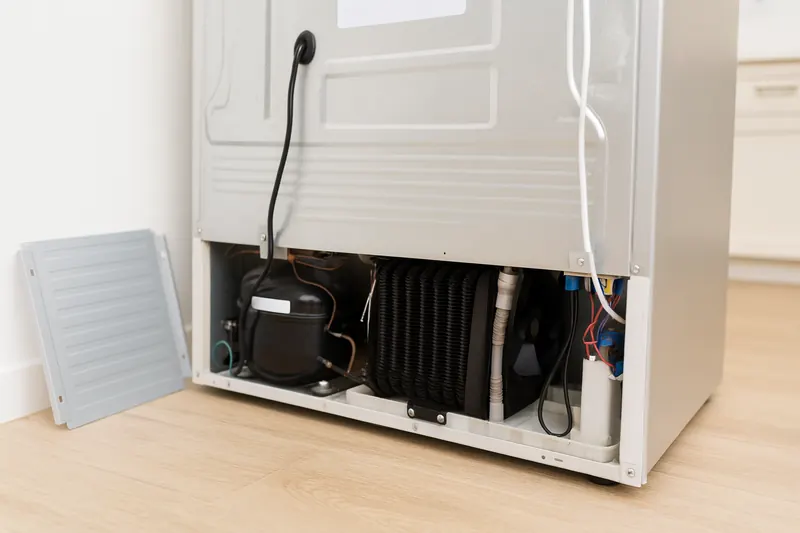
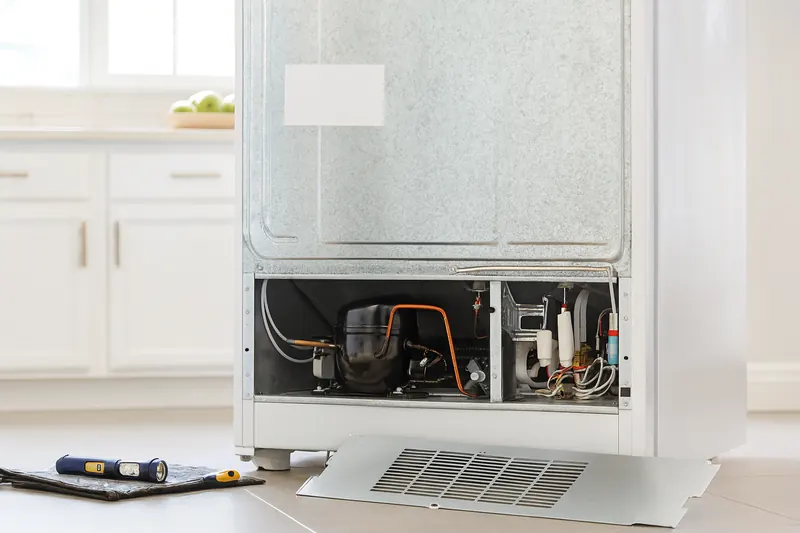
| Click, brief hum, click again every 2–5 minutes | Compressor area (bottom rear; top on built-ins) | Getting warmer | Compressor start attempt and overload trip |
| A single click, then a steady hum | Compressor area | Normal | Normal compressor start |
| Click, then a buzz for a few seconds | Back of the unit | Normal | Water valve opening for the ice maker |
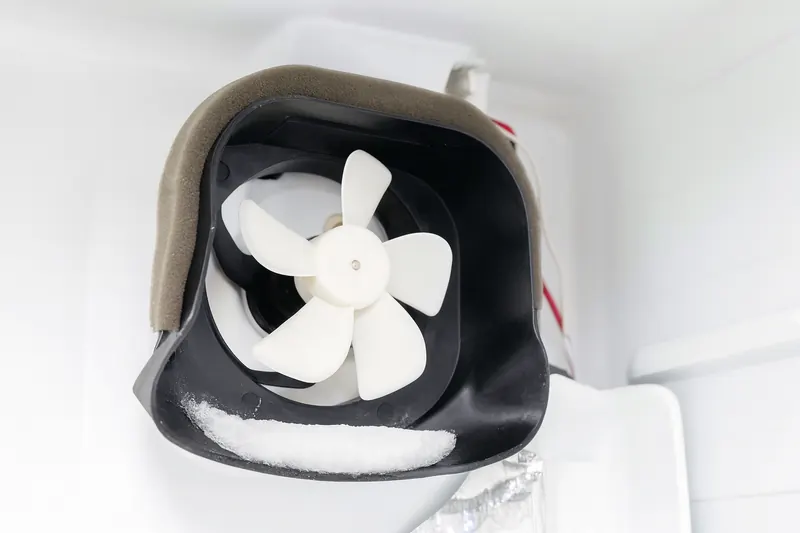
| Ticking or clicking from the freezer that stops when the door opens | Freezer back wall | Often fading | Fan blade hitting ice |
| Click from inside the control area | Behind control panel | Normal | Relay on the control board — usually normal |
| Ticking during defrost | Freezer | Normal | Defrost heater and expansion — normal |
This page covers the first row: the compressor is trying and failing to start, or not trying at all.
What is happening
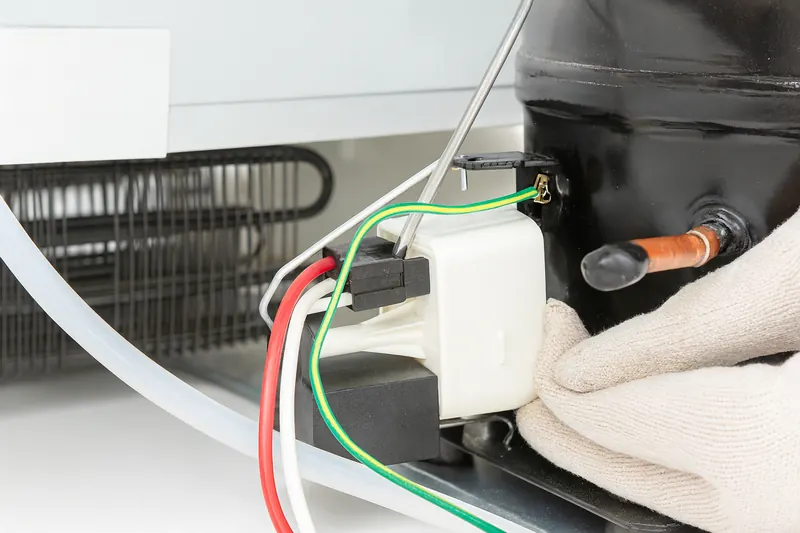
A conventional compressor needs extra help to start: a start relay (or PTC starter) briefly energizes its start winding. If the compressor cannot get turning, it draws very high current and heats up. The overload protector, a small thermal switch on the compressor, opens with a click, cools for a few minutes, closes with another click, and the cycle repeats.
Variable-speed (inverter) compressors work differently. An inverter board starts and drives the compressor electronically, so you may hear no click at all — just silence and a refrigerator that keeps warming, sometimes with an error code.
Possible causes, from simplest to most serious
High head pressure from a dirty condenser or failed condenser fan
A compressor starting against high pressure in a hot room struggles to turn over, especially right after a short power interruption. Clues: worst on hot afternoons; the condenser is dusty or its fan does not spin. Repair: clean the condenser, replace the condenser fan.
Failed start relay or overload
These are inexpensive parts and fail on refrigerators of every brand. Clues: repeated click-hum-click with the compressor case getting hot. Repair: replace the relay and overload as a set.
Low voltage or a poor connection
Extension cords, a loose outlet, or a heavily shared circuit can drop voltage during the start surge. Clues: the lights dim when the compressor tries to start; the problem disappears when plugged into a different, dedicated outlet.
Inverter board failure
On many LG, Samsung, Whirlpool, GE and built-in models, a failed inverter board leaves a healthy compressor sitting idle. Clues: no clicking, no hum, fans running, possibly an error code. Repair: confirm the board's output, then replace the board. See control board repair.
Compressor seized or failed electrically
Internal mechanical wear or a failed winding means the compressor itself must be replaced. Clues: the relay and overload test good, voltage is correct, and the compressor still will not start; windings test open or shorted. Repair: compressor replacement. On LG refrigerators with linear compressors, check whether LG's extended compressor warranty covers the part — see LG refrigerator repair.
What you can safely check
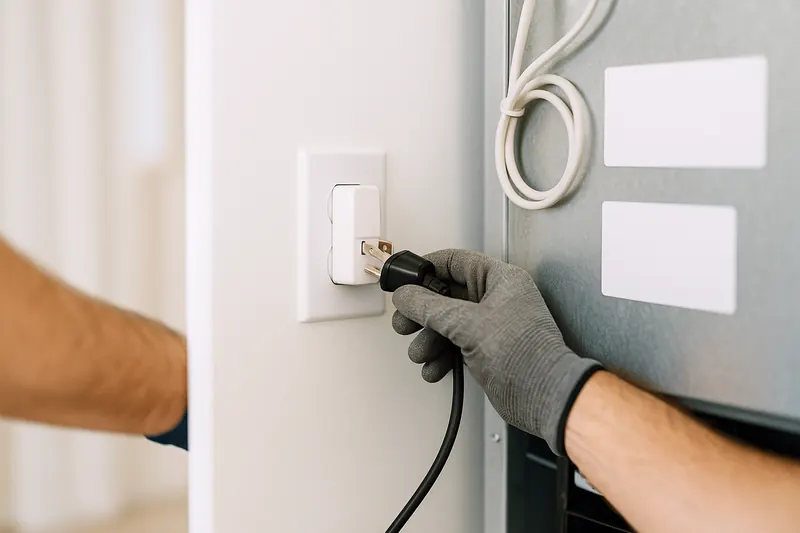
- Plug the refrigerator directly into a wall outlet — no extension cords or power strips.
- Unplug it and vacuum the condenser coil; make sure the condenser fan spins freely by hand.
- Note how often the click repeats and whether you hear a hum before it. Tell the technician.
- If you smell burning or the breaker trips, leave it unplugged.
Do not remove the relay cover or touch compressor terminals with power applied. The terminals carry line voltage and the compressor shell can be very hot.
What a refrigerator technician checks
- Supply voltage at the outlet and at the compressor during the start attempt
- Start relay and overload condition
- Compressor winding resistance and insulation to ground (power off)
- Starting current and whether the compressor turns over
- Inverter board output on variable-speed models
- Condenser condition and fan operation
Frequently asked questions
Why does my refrigerator click every few minutes?
Most often because the compressor is trying to start and the overload protector is tripping. Causes range from a failed start relay to a dirty condenser to a failed compressor, so the repair is not always expensive.
Does clicking mean my compressor is bad?
Not necessarily. Start relays, overloads, condenser airflow and low voltage cause the same click. A technician tests those before condemning a compressor.
How much does it cost to fix?
A start relay and overload repair is one of the less expensive repairs — see pricing. Inverter boards and compressors cost more.